
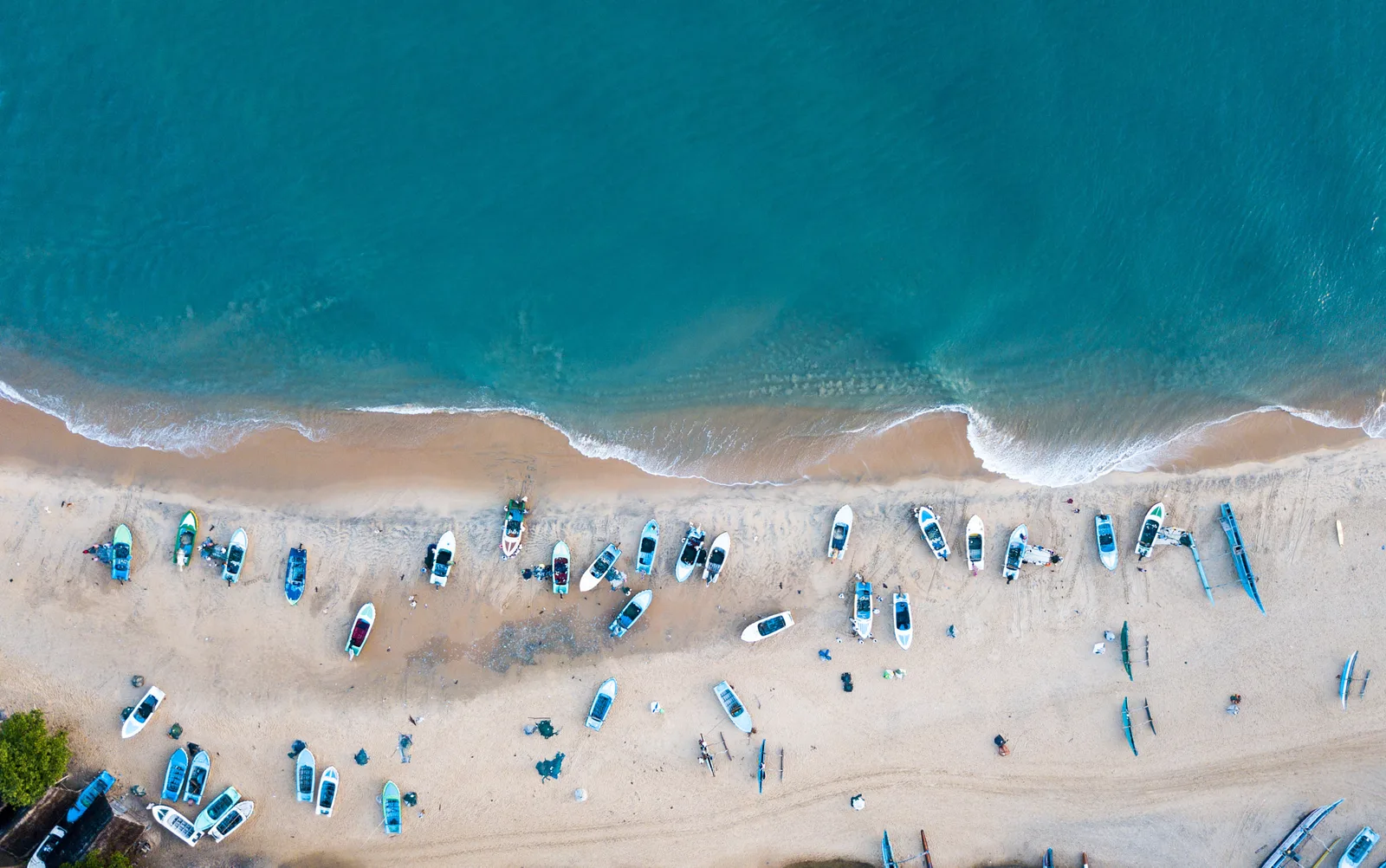
Four surf bases, four ways to shape the trip
Scroll sideways to compare all columns.
| Surf base | Typical planning season | Experience and surf setting | Route planning |
|---|---|---|---|
| Weligama | South coast: usually November–April | A broad beach-break setting to discuss for lessons; nearby reef waves are a separate choice | Consider a coast base between Galle and Mirissa |
| Hiriketiya | South coast: usually November–April | A compact bay with a beach break and a separate left over reef; choose the section with a coach | Consider between Matara and Tangalle, near Dikwella |
| Hikkaduwa | Southwest coast: usually November–April | Distinguish Narigama beach-break lessons from Main Reef and Benny’s | Consider a southwest stay connected with Galle and the south coast |
| Arugam Bay | Southeast: roughly April–October; June–September is a commonly identified core period | Several different point-break outings; Main Point is not the same as a beginner lesson location | Give the southeast a real stay, with Ella or the southeast as adjoining chapters |
The south and southeast have different seasonal rhythms.
For Weligama, Hiriketiya and Hikkaduwa, November to April is a useful general planning window. Some operators start their season in October, but a camp’s opening date does not guarantee suitable ocean conditions. Treat October as a transition month and discuss your dates locally.
For Arugam Bay, the broad main window is roughly April to October, with June to September commonly described as the core surf period. Sources disagree about the boundary months, so April and October deserve flexibility. Some lessons run outside the main season when conditions allow; that is different from promising dependable surf throughout the year.
These are seasonal patterns, not a forecast for your session. Wind, swell, tide, local hazards and the individual break all matter. A coach should assess the conditions and your ability before choosing where to enter the water.
Weligama: a useful starting point for learning on the south coast.
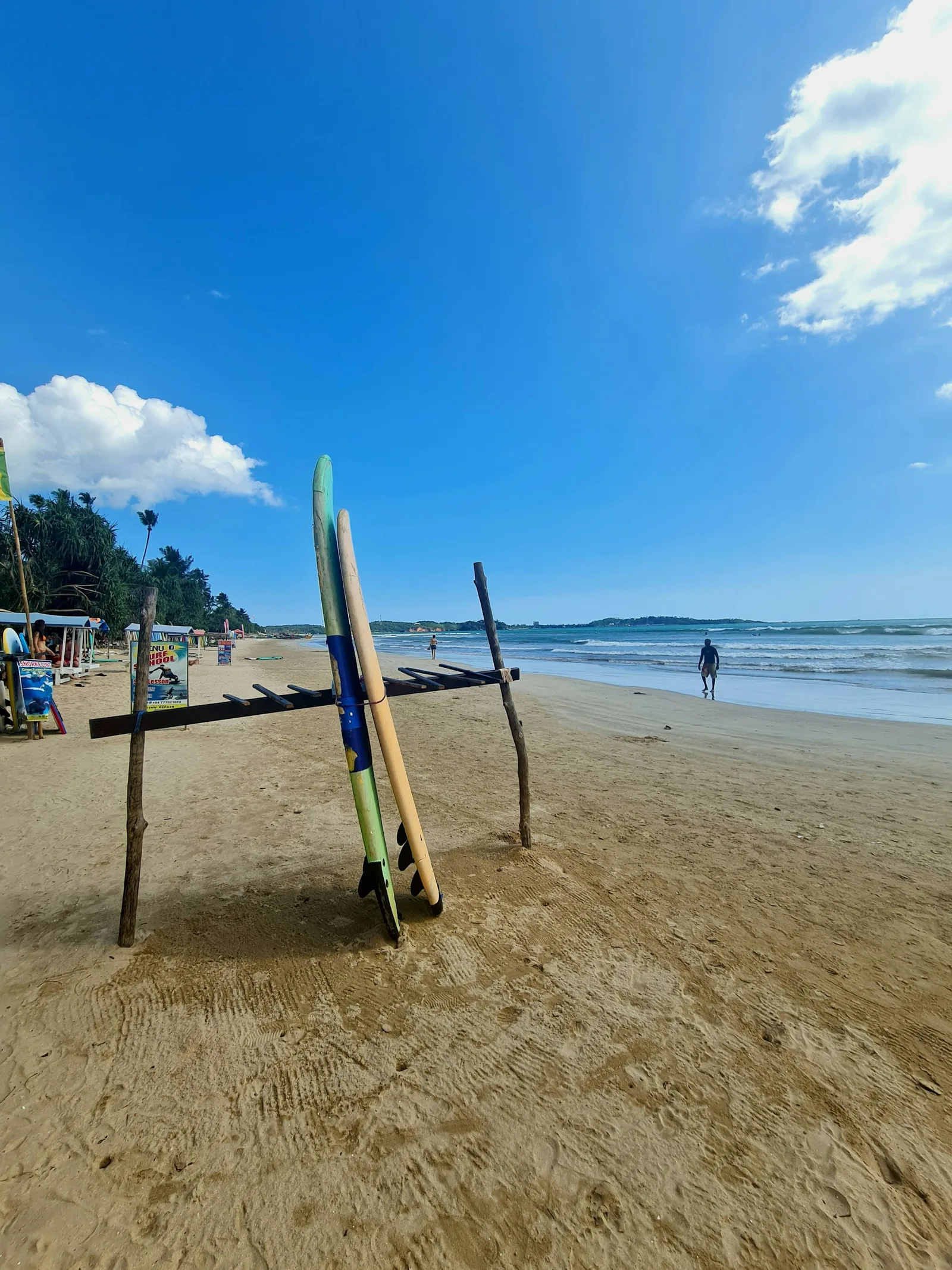
Weligama’s broad bay and beach-break learning scene make it a strong candidate for a first surfing base. Start by discussing an instructor-led lesson in a suitable section, rather than hiring a board and assuming every wave in the bay will suit you.
Nearby reef waves offer a different experience from beginner whitewater. Tell your coach whether you have never surfed, are learning to catch waves independently or already ride unbroken waves. A sandy bottom does not mean there are no currents, collisions or other hazards.
As a route idea, settle into Weligama and consider Galle or Mirissa outings around lessons and rest. That can leave more time for the water than changing hotels at every neighbouring beach.
Hiriketiya: a small bay with more than one kind of wave.
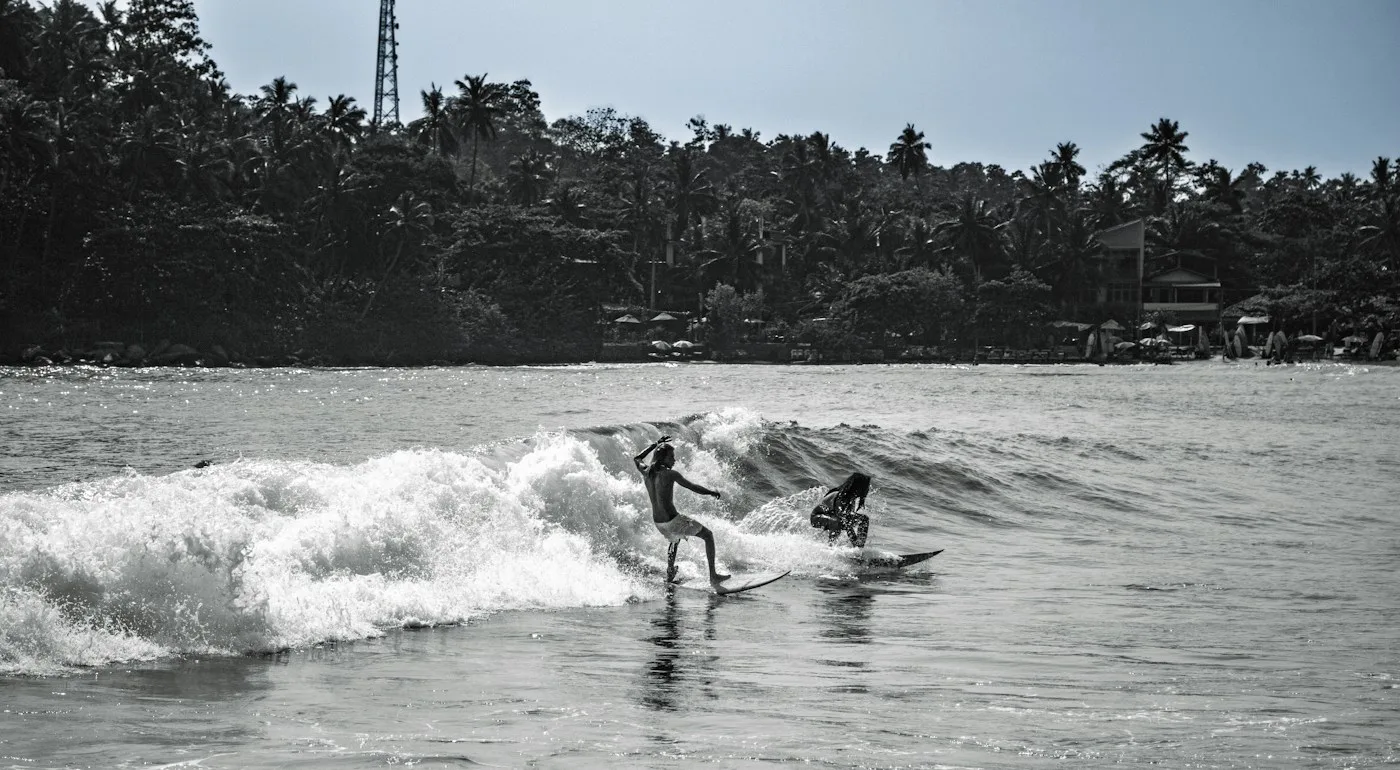
Hiriketiya has a beach-break setting and a separate left-hand wave over reef. Those are different choices: the existence of beginner lessons does not make the reef wave appropriate for a first-timer. Let a coach choose a suitable section and session for your experience.
The compact bay also makes sharing the water part of the experience. Discuss surf etiquette and other water users before a lesson, and do not use a photograph of someone riding a wave as a guide to what you should attempt.
Hiriketiya is near Dikwella, east of Matara town. Consider it between Matara and Tangalle, giving the bay time of its own rather than squeezing it into a short town visit.
Hikkaduwa: separate beach lessons from reef surfing.


When discussing a first lesson in Hikkaduwa, ask about the Narigama beach-break setting and the conditions for your session. Hikkaduwa’s Main Reef and Benny’s are different environments, with reef and more demanding waves; their reputation is not a reason for a beginner to paddle out there.
For a wider journey, Hikkaduwa can be a southwest base connected with Galle and the southern coast. Decide whether you want repeated surf sessions or a single lesson alongside other interests before adding several beach stays to the route.
Arugam Bay: plan a southeast surf chapter, not a quick detour.
Arugam Bay is a base for several separate surf outings. Its famous Main Point should not be treated as the default beginner location. Lessons for different levels are available, but the instructor should select the break according to conditions, crowds and your ability.
Avoid fixing the whole trip around a named beginner spot working every day or in every month. Share what you can do independently in the water, and allow room for a different spot or a changed session.
As a route-planning idea, give Arugam Bay a proper stay when connecting with Ella or the southeast. It is a different coast from Galle and Weligama. On a short trip, choosing one surf region may give you more time to enjoy it than trying to include both.
Trying surfing and travelling to surf are different plans.
If you want to try a lesson, choose a base that already fits your holiday. If surfing is the main reason for travelling, leave room for repeated sessions, rest and changing conditions. There is no reliable number of lessons that guarantees you will stand up or become an independent surfer.
Before choosing a school, ask about swimming requirements, instructor experience and current qualifications, group size, equipment, ability assessment and what happens when conditions are unsuitable. Clarify transport and inclusions separately. Board rental is not a substitute for instruction.
For companions who do not surf, consider nearby destination outings and time together at the chosen base. Do not assume a surf beach is suitable for swimming. Share board bags as well as passengers and luggage when discussing your road vehicle; space and arrangements need confirming.
- Describe your experience honestly, including swimming confidence and what you can do without assistance.
- Check wind, swell, tide and local advice for the selected break; know your limits and respect other water users.
- Discuss lessons with a suitable independent operator. This guide does not confirm a surf-school booking or partnership.
What to share when planning a surf stop
Share only what you already know. The remaining questions can be discussed as the plan becomes clearer.
- Travel dates or month, total nights and arrival/departure plans
- First lesson, learning independently or experienced surfing
- Which coast or places you already have in mind
- Booked hotels and fixed activities, in route order
- Travellers, non-surfing companions and practical needs
- Board bags, luggage and any lessons already booked
Things worth asking before you decide.
When is the best time to surf in Sri Lanka?
Choose the coast first. November–April is a useful general window for the south and southwest. Arugam Bay’s main season is roughly April–October, with June–September commonly identified as the core period. Boundary months vary, and the selected break still needs a conditions check for your session.
Is Weligama or Arugam Bay better for beginners?
Dates and route come first. Weligama’s beach-break learning setting makes it a strong south-coast candidate. Arugam Bay also has beginner lessons at suitable locations, but the famous Main Point is not the default beginner wave. Choose a coach who assesses your ability and the day’s conditions.
Is all of Hiriketiya suitable for a first lesson?
No. The bay has a beach break and a separate reef wave. An instructor should choose an appropriate section; a destination offering lessons does not mean every break there suits a beginner.
Where should I ask about beginner surfing in Hikkaduwa?
Ask a suitable coach about Narigama beach-break lessons for your dates and experience. Main Reef and Benny’s are separate, more demanding settings. Do not select a reef wave simply because it is well known.
Can I combine surfing with sightseeing or safari?
Yes, as a route to discuss. Choose a coast base, allow time for lessons and rest, then consider adjoining destinations or a well-placed safari stop. Avoid assuming several distant activities fit comfortably into one day.
Does a private-driver enquiry include surf lessons?
No lessons are confirmed by an enquiry. Discuss road transport, board bags and any independently booked activities, then clarify each inclusion in the agreed arrangement. This guide does not advertise a verified surf-school partnership.
Sources and review date.
Practical arrangements still need confirmation for your dates. Information reviewed 8 October 2026.
- Sri Lanka Tourism — climate and seasons
- Island Surf School — Arugam Bay season and lesson questions
- Dylan’s Surf Company — Arugam Bay lessons and spot selection
- Lanka Surf House — south-coast season guidance
- Soul & Surf — historical Sri Lanka surf-break guide
- Hiri Surf School — Hiriketiya beach and reef settings
- Hikka Surf School — Narigama and Hikkaduwa reef settings
- RNLI — general surfing safety advice (UK/Ireland context)
Tell us what you know so far.
We can discuss the practical route, vehicle and quotation before anything is confirmed.